



Pinterest comes with its own built-in scheduler inside Pinterest Business tools. It is free with a Pinterest business account, it lives directly inside Pinterest, and for many Pinterest-first workflows it is genuinely enough. FS Poster is a WordPress plugin that pushes content to 26 social networks (Pinterest included) the moment a post or product is published, with a Calendar and a recurring Planner on top.
The two tools overlap on the surface ("schedule a Pin for later") but solve different problems underneath. This guide compares them on workflow, scheduling depth, content control, WooCommerce fit, and cost, then gives a clear answer for who should pick which.
Pinterest Native Scheduler vs FS Poster: Quick Verdict
Choose the Pinterest native scheduler if Pinterest is the whole workflow. You design Pins inside Pinterest, you do not publish from WordPress on a fixed cadence, you want a free tool inside Pinterest Business with Pinterest Trends, Pinterest Analytics, and native shopping support, and you are comfortable working within the platform's own constraints: a Pinterest business account, up to 30 days of forward scheduling, one Pin scheduled at a time, and up to 10 future scheduled Pins per account.
Choose FS Poster if WordPress (or WooCommerce) is the source of your content and Pinterest is one destination in a multi-channel publishing system. You want new posts and products to auto-pin to Pinterest at publish time, you want the same workflow to also publish to Facebook, Instagram, LinkedIn, TikTok, X, Threads, Bluesky, and 19 other networks, and you want a recurring Planner that recycles archive content without manual work.
Overall winner: depends on where your content starts. Pinterest native scheduler wins on free, platform-native polish, and Pinterest-only depth. FS Poster wins on WordPress-driven publishing, network breadth, and recurring automation. The honest call is "neither is better than the other across the board; one of them is wrong for your workflow."
Quick Comparison Table
| Category | Pinterest Native Scheduler | FS Poster |
|---|---|---|
| Where it lives | Inside Pinterest Business tools (web and mobile app) | WordPress admin (plugin) |
| Account required | Pinterest business account (free upgrade from personal) | WordPress site + FS Poster licence |
| Starting price | Free with a Pinterest business account | $58/ |
| Lifetime option | Free, no paid tier needed | $490 one-time intro for 30 websites |
| Supported networks | Pinterest only | 26 networks including Pinterest, with multi-board support |
| Schedule from WordPress on publish | No | Yes, auto-share on publish included on every plan |
| Scheduling window | Up to 30 days ahead | Unbounded (any future date / time) |
| Future scheduled Pin cap | Up to 10 future scheduled Pins per account | No per-account cap |
| Bulk scheduling | One Pin at a time only (no bulk action) | WP Posts-list bulk action + Planner wizard |
| Recurring evergreen planner | No | Yes, Interval / Weekly cadence with sleep-time exclusion |
| Content customization per network | N/ | Per-network captions, template variables, AI captions |
| WooCommerce product auto-share | No | Yes, native, with per-channel category filters |
| Pinterest Analytics + Trends | Built in | Included Pinterest reach via FS Poster shares; native Analytics and Trends still come from Pinterest itself |
| Best for | Pinterest-first creators, brand managers, image-driven businesses | WordPress publishers, WooCommerce stores, agencies, multi-site operators |
Pinterest native scheduler details checked from public Pinterest documentation in June 2026. FS Poster pricing checked on fs-poster.com in June 2026.
Pinterest Native Scheduler Overview
Pinterest's native scheduler is a feature inside Pinterest Business tools. The first requirement is a Pinterest business account; a personal account can be upgraded to a business profile for free, which then unlocks the scheduling option in the Pin Builder. Once that is done, you get a "Publish at a later date" choice whenever you create a Pin. You upload the image or video, write a title and description, add alt text, pick the destination URL, choose the board, and set the publish date and time. Pinterest queues the Pin and pushes it live at the moment you picked.
The scheduler itself is free with the business account. There is no subscription, no per-account fee, and no separate plan to buy. Pinterest also bundles the rest of its native business suite alongside the scheduler at no extra cost: Pinterest Trends for keyword research, Pinterest Analytics for impressions, saves, outbound clicks, and audience insights, Idea Pin and video support, shopping features for product catalogues, and the Pin Builder's own composer for image and video Pins.
The practical limits worth knowing are platform constraints, not paywalls. According to Pinterest's own Business Help documentation, a Pin can be scheduled up to 30 days in advance of the current date, you can only schedule one Pin at a time (no bulk scheduling action), and an account can hold up to 10 future scheduled Pins in the queue at once. After scheduling, you can edit a Pin's publish date, title, board, description, and link, but the image or video content itself cannot be swapped. Those rules are generous enough for solo creators planning a few Pins per week, but they become a real constraint once a brand wants to queue dozens of Pins across multiple boards or plan a full quarter of content in one sitting.
Where the native scheduler is not strong is everything outside Pinterest. It does not read from WordPress, does not auto-publish a Pin when a new blog post or WooCommerce product goes live, does not customise captions for non-Pinterest channels (because there are no other channels), and does not run a recurring evergreen schedule that recycles older Pins on a cadence. Each scheduled Pin is a one-off entry in the queue, built by hand.
FS Poster Overview
FS Poster is a WordPress plugin from FS Code that turns any WordPress site, including WooCommerce stores, into a multi-network social publishing engine. It auto-shares new posts, pages, custom post types, and WooCommerce products to 26 social networks the moment they are published. Pinterest is one of those networks, with full multi-board support, so a single WordPress post can fan out to multiple Pinterest boards in one publish action.
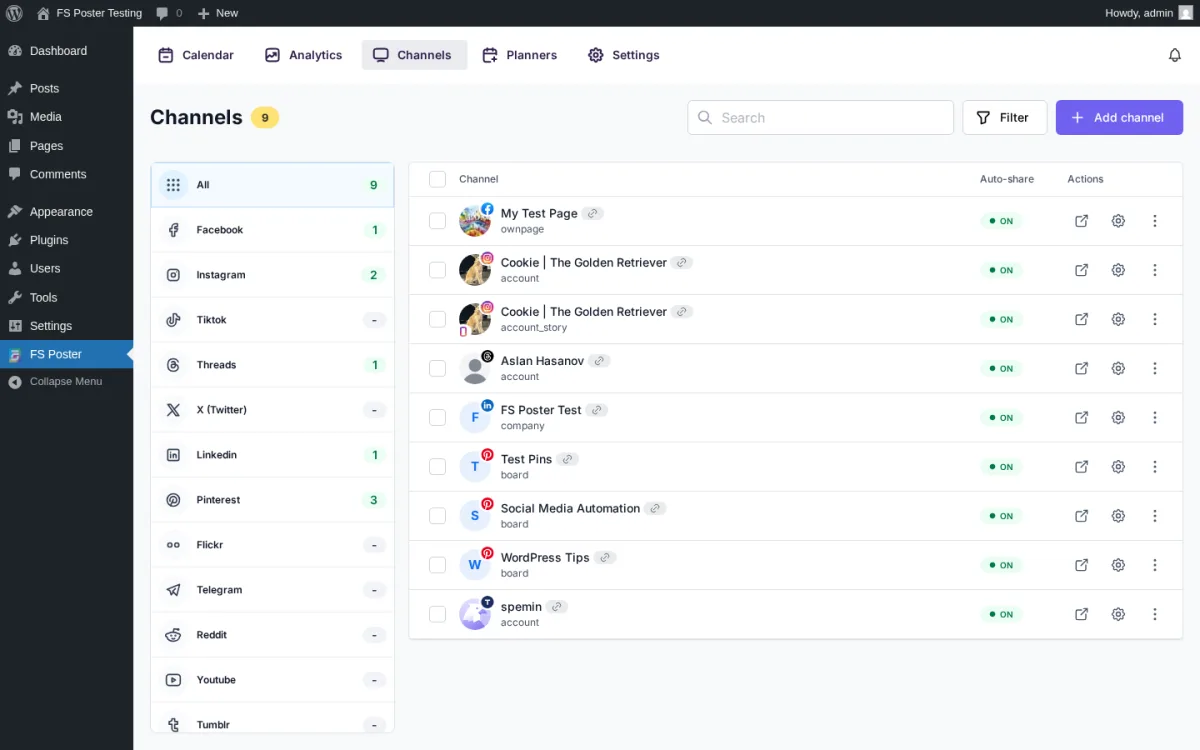
Outside auto-share, FS Poster gives you a modern Calendar view to schedule one-off shares with the WordPress media library attached, a recurring Planner that recycles archive content on a chosen cadence (every N days, every N weeks, on specific weekdays, with optional sleep-time exclusions), and a native WordPress Posts-list bulk action that drops selected posts into the Planner wizard in one move. Captions can be customised per channel with template variables like {title} and {short_url}, captions and share images can be generated with AI (using the buyer's own OpenAI key), and per-channel category filters let a Pinterest board receive only posts tagged with a specific WordPress category.
Pricing is flat per site. The Single plan starts at $58 per year intro ($65 renewal) for one site, Plus is $109 per year intro ($195 renewal) for three sites, Developer is $229 per year intro ($449 renewal) for fifteen sites, and the headline tier is a $490 one-time Lifetime licence for thirty sites with 12 months of support included and updates included for life. There is no free version. The plugin is sold exclusively through fs-poster.com with a 14-day money-back guarantee.
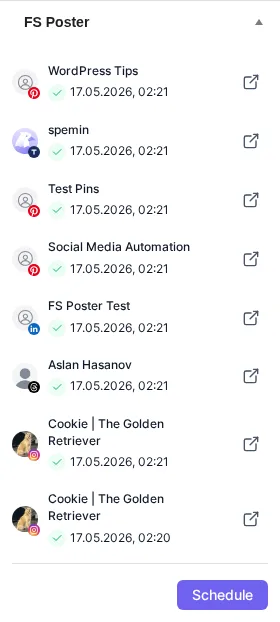
In hands-on testing on 2026-05-17, FS Poster pushed a single WordPress post to three Pinterest boards (Test Pins, Social Media Automation, and WordPress Tips) and we captured live Pinterest URLs for the resulting pins. The image was carried through, Pinterest's own image recognition correctly identified it, and each board received its own pin. That is the workflow a WordPress publisher gets in production.
Head-to-Head Comparison
Pricing and Plans
Pinterest's native scheduler is free for any Pinterest business account. There is no plan to pick, no paywall on the scheduling feature itself, and Pinterest Trends, Pinterest Analytics, and the shopping suite are bundled at the same zero cost. The only "cost" is the platform constraint: scheduling reaches up to 30 days ahead, one Pin can be scheduled at a time, and an account can hold up to 10 future scheduled Pins at once.
FS Poster is paid, with the cheapest plan at $58 per year intro on Single. The Lifetime tier at $490 one-time is the long-run economic play for anyone who plans to keep publishing for more than two years, especially across multiple sites, because it removes the renewal cost entirely. There is no free plan, but the 14-day money-back guarantee covers the entire range, including Lifetime.
Winner: Pinterest native scheduler. Free always beats paid on cost. The honest qualifier is that "free" only matters if Pinterest alone is enough; FS Poster's cost only becomes relevant once a WordPress-driven multi-network workflow is the requirement.
Network Coverage
Pinterest native scheduler is, by design, Pinterest-only. You cannot use it to schedule a post to Facebook, LinkedIn, Instagram, X, Threads, Bluesky, or any other network.
FS Poster supports 26 networks on every plan: Facebook, Instagram (feed plus Story), X (Twitter), LinkedIn (profile plus company page), Pinterest (with multi-board support), Threads, Truth Social, TikTok, YouTube Community, YouTube Shorts, Google Business Profile, Telegram, Reddit, Discord, Blogger, Medium, Tumblr, VK, Odnoklassniki, Xing, Plurk, Bluesky, Mastodon, Flickr, WordPress (post to another WordPress-based site), and a Webhook destination for Zapier, IFTTT, or any custom HTTP target.
Winner: FS Poster. No contest on breadth. Pinterest's coverage is one network because that is what the tool is for.
Auto-Posting Workflow
Pinterest's native scheduler is a manual workflow. Every Pin is built inside Pinterest, by you, in the Pin Builder. Even if a WordPress blog post is the source of the Pin, you have to download the image (or capture a screenshot), open Pinterest, click Create Pin, upload the image, write a fresh title and description, paste the WordPress post URL, choose the board, and pick a publish time. Repeat for every Pin, every board, every week.
FS Poster auto-shares at publish time. When a WordPress post or WooCommerce product is published with a featured image, FS Poster schedules the share to every channel that has Auto-share enabled. Pinterest boards behave the same way: each connected Pinterest board with Auto-share on receives its own pin built from the post's featured image, the post title (or a customised template), and the post URL. In testing this fired in production with no manual intervention.
The two patterns are different categories. Pinterest native is build-the-Pin-yourself; FS Poster is generate-the-Pin-from-the-WordPress-post. For a WordPress site publishing two or three posts a week to four Pinterest boards, the time difference is the difference between zero manual Pin creation and around a dozen manual Pin builds per week.
Winner: FS Poster. Pinterest's manual workflow is fine for image-first creators who never write blog posts. For WordPress publishers, the automation gap is large.
Scheduling, Calendar, and Planner
Pinterest's native scheduler is a simple queue. Each scheduled Pin is a single entry with a date and time. Pinterest does not provide an editorial calendar view across the queue, a drag-and-drop reschedule UI in calendar form, or a recurring evergreen rule that auto-recycles older Pins.
FS Poster ships a Calendar view with Month, Week, and List modes. Day cells stack share cards with status colours (green for success, red for failure). Clicking any card opens a share-detail modal with a channel-avatar row at the top, per-channel status, the original caption, the sharing timestamp, and Retry, Delete, Reschedule, and Insights buttons. The Planner module is the more powerful surface: a four-step wizard (Filter, Share type, Sort, Summary) builds a recurring schedule, with Interval cadences ("every N days/weeks") that can carry sleep-time exclusion windows and Weekly cadences that pin to specific weekdays. Source posts are filtered by post type, specific posts, publish date range, or term (category, tag, taxonomy).
The native WordPress Posts-list bulk action is the most underrated FS Poster feature in this category. Select 20 archive posts on the Posts list, choose "Bulk Schedule [FS Poster]", and the plugin drops you into the Planner wizard with those 20 posts pre-filtered. One move rehydrates a quarter of evergreen content into the social pipeline.
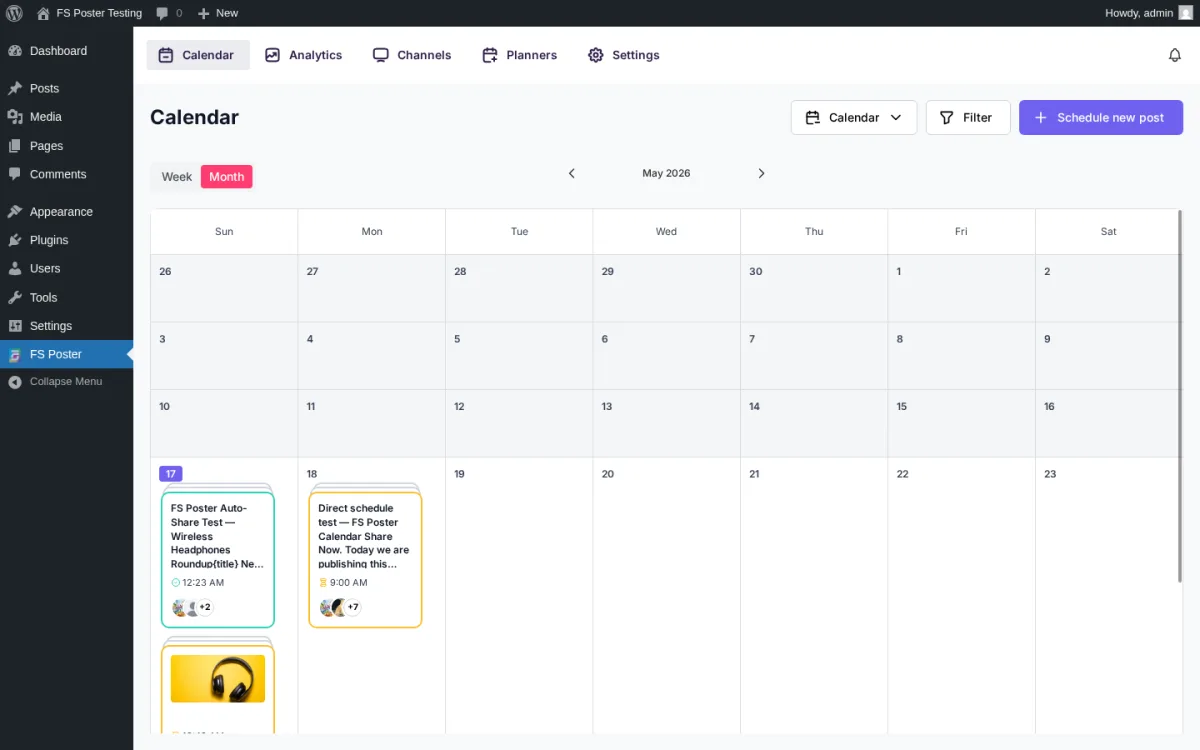
Winner: FS Poster. Both tools schedule a Pin, but FS Poster also runs a Calendar, a recurring Planner, a sleep-time exclusion window, and a bulk archive rehydration flow. Pinterest's native scheduler does not compete on those axes by design.
Content Customization and AI
Pinterest's native scheduler is also a Pin composer. The Pin Builder lets you upload one image or video per Pin (still or carousel), write a title, write a description, add alt text, pick the destination URL, choose the board, and add Pinterest tags. Pinterest's own AI is being layered into the Pin creation flow over time, primarily for image suggestions, title/description ideas, and product tagging.
FS Poster's per-channel customise-content editor lets you write a different caption for every connected channel, including each Pinterest board, using template variables ({title}, {short_url}, {post_excerpt}, {post_link}). A one-click "Use AI" button generates a caption tuned to that channel using the buyer's own OpenAI key; FS Poster does not bundle AI quota. AI image generation is available on the same key. The editor also includes a Keywords helper for hashtag generation, a Preview mode, and a raw HTML mode for power users. AI Templates can be reused across channels.
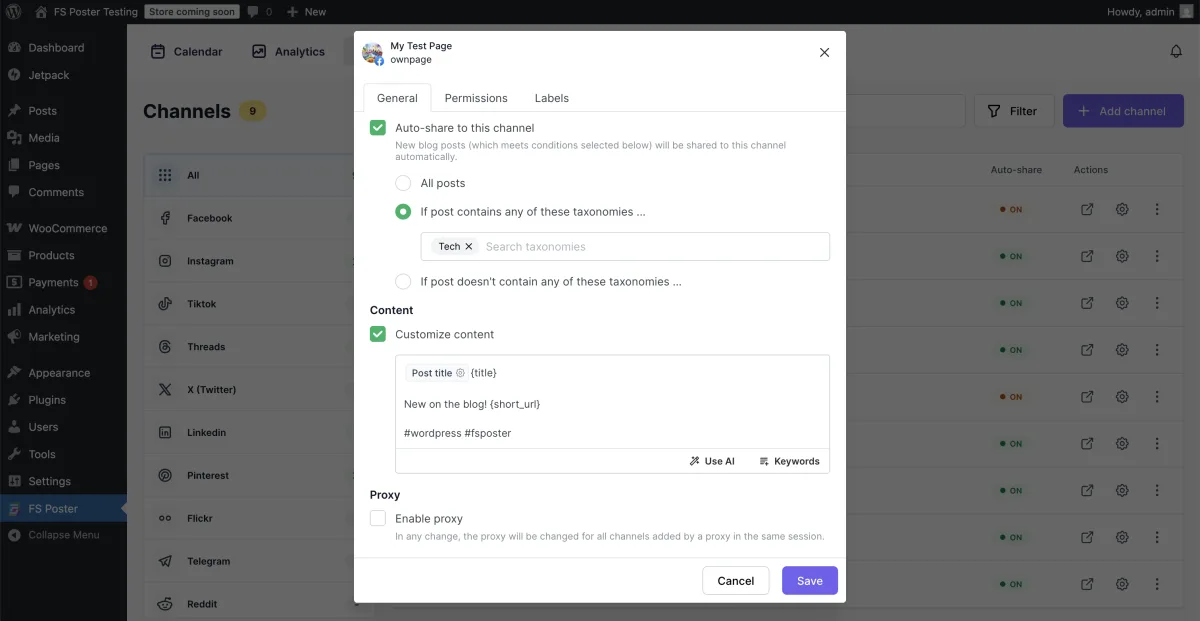
Pinterest native has the advantage that its composer is built for one network and tuned to Pinterest's exact conventions (Pinterest-style title, Pinterest-style description, alt text, board choice, hashtags, rich pins). FS Poster's editor is multi-network and reuses the same surface across all 26 destinations.
Winner: tie, depends on use case. Pinterest native is the cleaner composer if every Pin is hand-built. FS Poster is the cleaner composer if every Pin starts as a WordPress post and the same caption logic needs to fan out to other networks too.
WooCommerce and Custom Post Types
Pinterest's native scheduler does not connect to WooCommerce. Pinterest has its own catalogue integrations (product feeds, the Shopify integration, the Pinterest API for Shopping) for store-side workflows, but those are separate from the scheduler and require their own setup, not the scheduler UI.
FS Poster is WooCommerce-native. When WooCommerce is active and Product is in the Allowed post types list (which it is by default after Woo activation), every new product publish triggers the same auto-share pipeline to every connected channel, Pinterest boards included. Per-channel category filters apply to products too, so a Pinterest board can be configured to receive only products tagged with a specific category. The FS Poster sidebar panel on the product edit screen shows per-channel status with timestamps and deep-links to live social posts, with a Retry button on any share that failed for a network-side reason.
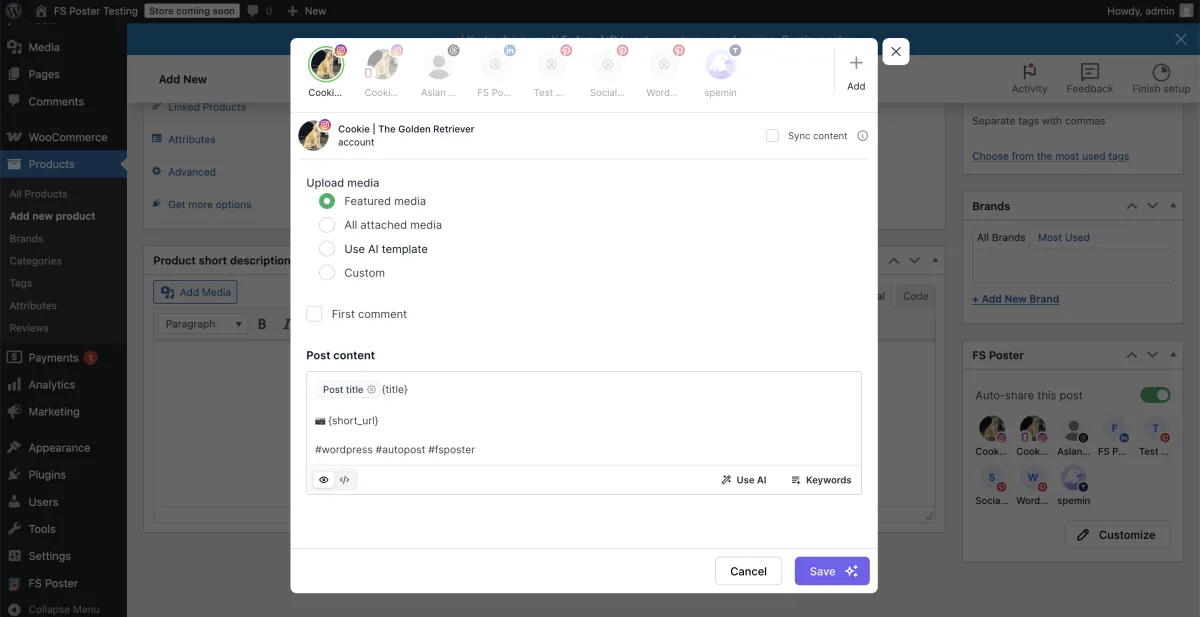
Winner: FS Poster. For WooCommerce stores that want product pins from WordPress, FS Poster is the workflow. Pinterest's native scheduler is not built for that loop.
Ease of Use
Both tools are easy in their own context.
Pinterest native is the easiest scheduling workflow to learn if you already use Pinterest. The Pin Builder is the same surface used to publish Pins immediately; the only difference is the "Publish at a later date" toggle. No installation, no plugin, no WordPress permissions, no separate dashboard. The trade-off is that everything has to happen inside Pinterest, by you, manually.
FS Poster is a WordPress admin plugin. Installation is a standard upload-and-activate flow. The first-run setup involves connecting Pinterest (and any other networks you want to use) through FS Poster's Standard Apps via a one-click OAuth flow, then turning Auto-share on for each channel. After that, the day-to-day workflow disappears: posts publish from WordPress as usual, and the Pin appears on Pinterest without anyone touching Pinterest. The five-tab top-level layout (Calendar, Channels, Planners, Analytics, Settings) is easy to orient.
Winner: tie. Pinterest is easier for Pinterest-only creators. FS Poster is easier for WordPress publishers because the work effectively disappears after setup.
Logs, Reliability, and Troubleshooting
Pinterest's native scheduler runs entirely on Pinterest's infrastructure. If a Pin fails to publish, Pinterest handles the surface: notifications appear inside the Pinterest app, and the Pin is moved back to the queue or to a failed state. Reliability is the platform's responsibility. The downside is that troubleshooting is limited to what Pinterest exposes in its UI.
FS Poster keeps a per-share log inside the WordPress admin. The Calendar share-detail modal shows each channel's status, the original caption, the sharing timestamp, and a Retry button on any failed row. Failure messages are explicit: when Instagram or Pinterest needs a featured image that was not attached, the modal returns "An image is required to pin on board." Add the featured image, click Retry, and the share fires without rebuilding the schedule. Server cron is recommended over WordPress's pseudo-cron for predictable timing, and FS Poster surfaces a "Configure cron jobs (Recommended)" toggle in Settings to make the recommendation explicit.
Winner: FS Poster. Per-channel logs and an in-place Retry button beat Pinterest's app-level notifications when something needs to be fixed at the WordPress side.
Support, Docs, and Reputation
Pinterest is Pinterest. Help documentation is extensive, the Business help center is well-maintained, and the platform itself has hundreds of millions of monthly users. There is no "vendor reputation" question to answer for the scheduler itself; it is Pinterest's own tool.
FS Poster is a paid plugin from FS Code. Public reputation signals include a 4.9 / 5 rating from 650+ reviews on fs-poster.com, 25K+ paid customers, 50K+ active installs, more than eight years in market, and Power Elite Author standing on CodeCanyon (referenced only for reputation, not as a sales channel). Support runs through fs-poster.com tickets and a Discord community. Release cadence is frequent, with multiple v7.x updates over the past 12 months.
Winner: tie. Different surfaces, both mature. Pinterest's reputation is platform-level; FS Poster's is plugin-level.
Pinterest Native Scheduler vs FS Poster Scorecard
| Category | Winner | Why |
|---|---|---|
| Pricing | Pinterest native | Free always beats paid on raw cost |
| Network coverage | FS Poster | 26 networks, including Pinterest, on every plan |
| Auto-posting from WordPress | FS Poster | Manual Pin building does not compete with auto-share on publish |
| Scheduling depth (Calendar, Planner) | FS Poster | Calendar view, recurring Planner, sleep-time exclusions, bulk action |
| Content customization and AI | Tie | Pinterest cleaner for Pinterest-only; FS Poster cleaner for multi-channel |
| WooCommerce and custom post types | FS Poster | Product auto-share with per-channel category filters |
| Ease of use | Tie | Easier inside each tool's own context |
| Logs and reliability | FS Poster | Per-share log + in-place Retry inside WordPress |
| Support and reputation | Tie | Platform-level vs plugin-level, both mature |
| Overall | Depends on workflow | Pinterest native wins for Pinterest-only creators; FS Poster wins for WordPress / WooCommerce publishers using Pinterest alongside other networks |
Who Should Choose the Pinterest Native Scheduler?
Choose the Pinterest native scheduler if:
- Pinterest is your only social channel and you do not need cross-network publishing.
- Your content is image-first or video-first, designed inside Pinterest rather than inside WordPress.
- You publish a small number of Pins per week and stay comfortably inside Pinterest's limits: a 30-day scheduling window, one Pin scheduled at a time, and up to 10 future scheduled Pins per account.
- You already have (or are willing to switch to) a Pinterest business account.
- You rely on Pinterest Trends, Pinterest Analytics, Idea Pins, and the shopping suite as your main planning surface.
- You do not want to pay anything for scheduling.
- You do not run a WordPress site, or your WordPress site is not the source of truth for the Pins you publish.
Who Should Choose FS Poster?
Choose FS Poster if:
- WordPress is the source of your content and you want new posts and products to auto-pin without manual work.
- You publish to Pinterest alongside Facebook, Instagram, LinkedIn, X, Threads, Bluesky, TikTok, or any of the 26 supported networks.
- You run a WooCommerce store and want product pins, including per-channel category routing, out of the box.
- You manage multiple boards on Pinterest and want one WordPress publish action to fan out to all of them with one tool.
- You want a recurring Planner that recycles archive Pins on a cadence (every two days, every week, on specific weekdays) without manual queueing.
- You manage three or more WordPress sites and want flat per-site licensing instead of per-account or per-board pricing.
- You are willing to pay $58 per year intro on Single (or $490 one-time Lifetime for 30 sites) in exchange for that workflow.
Can You Use Both Together?
Yes, and many Pinterest-strong brands do. The honest pattern looks like this:
- Use FS Poster to publish from WordPress on save. New blog posts and WooCommerce products fan out to Pinterest boards (and any other connected networks) automatically, with per-board caption templates.
- Use Pinterest's native scheduler for the Pins that do not start as WordPress content. Idea Pins, image-first creative content, behind-the-scenes shots, holiday graphics, and Pin Builder experiments live inside Pinterest's own queue.
- Use Pinterest Trends and Pinterest Analytics as the planning surface for Pinterest-specific creative direction, regardless of which tool actually publishes the Pin.
The two tools do not collide. They fill different ends of the workflow.
Alternatives to Consider
If neither Pinterest native nor FS Poster is exactly the right fit, three options are worth knowing about:
- Tailwind. The longstanding third-party Pinterest scheduler, with a calendar, SmartLoop recycling, and analytics built around Pinterest specifically. Best for Pinterest-only creators who have outgrown the native scheduler's 30-day window and 10-future-Pin queue cap and need more headroom for bulk scheduling. Paid, with a free tier for small accounts.
- Buffer or Hootsuite. Generic SaaS schedulers that include Pinterest as one of many supported networks. Best for marketing teams that already pay for a SaaS scheduler and want one tool across every network, accepting that Pinterest-specific depth is shallower than Tailwind or Pinterest native.
- Other WordPress auto-poster plugins. Blog2Social, Jetpack Social, Revive Old Posts, and others compete with FS Poster on the WordPress-driven publishing job. The best WordPress social media auto-posting plugins roundup compares the full shortlist in one place.
Pinterest Native Scheduler vs FS Poster FAQ
Is the Pinterest native scheduler enough on its own?
For Pinterest-only creators with a Pinterest business account, yes. The scheduler is free, reaches up to 30 days ahead, and Pinterest Trends and Pinterest Analytics are bundled at no extra cost. The trade-off is that you can only schedule one Pin at a time and an account can hold up to 10 future scheduled Pins. For WordPress publishers and WooCommerce stores that publish content to multiple networks, the native scheduler is not enough because it cannot read from WordPress and does not publish to anything other than Pinterest.
Can FS Poster replace the Pinterest native scheduler completely?
For WordPress-driven Pins, yes. FS Poster connects to multiple Pinterest boards, auto-pins on WordPress publish, and supports recurring Planner schedules that recycle archive content. For Pins that start inside Pinterest as Idea Pins or Pin Builder creative work, FS Poster is not the right tool because it publishes from WordPress, not from the Pinterest composer.
How far ahead can each tool schedule?
Pinterest's native scheduler supports up to 30 days in advance per Pinterest's Business Help documentation. You can only schedule one Pin at a time, and an account can hold up to 10 future scheduled Pins at once. FS Poster's Calendar and Planner can schedule arbitrarily far ahead and have no per-account scheduled-share cap; the Planner's recurring rules also generate future scheduled cards automatically.
Does FS Poster support multiple Pinterest boards?
Yes. Each board is a separate "channel" inside FS Poster's Channels view. Auto-share can be turned on or off per board, captions can be customised per board, and per-channel category filters let a board receive only posts tagged with a specific WordPress category or term.
Which tool is cheaper?
The Pinterest native scheduler is free. FS Poster is paid, starting at $58 per year intro on the Single plan ($65 renewal) and reaching $490 one-time on the Lifetime tier (which covers 30 sites). FS Poster's cost only matters if the WordPress-driven, multi-network workflow it provides is what you need; if Pinterest-only is the requirement, the native scheduler is the right answer.
Which tool is better for Pinterest analytics?
Pinterest's native analytics is the source of truth for impressions, saves, outbound clicks, and audience demographics, regardless of which tool published the Pin. FS Poster adds its own per-share Insights surface inside the Calendar share-detail modal, but Pinterest's own analytics is still where Pinterest-specific performance lives.
What about timing? When should I actually publish?
For per-network timing windows, the best time to publish on Pinterest guide collects the current windows that Pinterest's own engagement data suggests, and the Planner cadence inside FS Poster can be tuned to those slots if you want WordPress-driven Pins to land at Pinterest-friendly times.
Final Verdict
Pinterest's native scheduler and FS Poster are not really competitors in the strict sense. They overlap on the surface ("schedule a Pin for a later date") but solve different jobs underneath. Pinterest native is the right answer for Pinterest-only creators who build Pins inside Pinterest, want free scheduling, and lean on Pinterest Trends, Pinterest Analytics, Idea Pins, and the shopping suite as their planning surface. FS Poster is the right answer for WordPress publishers and WooCommerce stores that want Pinterest to be one well-served destination in a multi-network publishing system, with auto-pinning at WordPress publish time, multi-board fan-out, a Calendar, a recurring Planner, and flat per-site pricing capped by a one-time Lifetime tier.
If your content starts inside Pinterest, start with Pinterest's native scheduler and use it well. If your content starts inside WordPress, the FS Poster review walks through the hands-on workflow in full, and the FS Poster pricing page lays out the Single, Plus, Developer, and Lifetime tiers side by side so you can pick the right one for your site count. The honest call is to start with the workflow, then choose the tool.
Write once. Post to 26 networks.
- 26 social networks
- Schedule & auto-repost
- Runs inside wp-admin


