


Manual product sharing scales badly. Add one more WooCommerce category, one more language, or one more social channel and the workload doubles before your traffic does. This guide shows how to auto post WooCommerce products to social media with FS Poster end to end, with examples that match how stores actually run: product launches, restocks, seasonal drops, category-only campaigns, stock-aware exclusions, evergreen rotation, and per-channel measurement.
It is written for WooCommerce store owners and the agencies that run social for them. We assume you already know what WooCommerce is and want a practical playbook for WooCommerce social media auto posting, not another generic plugin roundup.
1. Why WooCommerce stores should automate product sharing
WooCommerce gives you a catalog, a checkout, and a content engine in one stack. What it does not give you is distribution. Every new SKU, every restock, and every seasonal collection has to travel from your WordPress admin to the channels where buyers scroll, or it might as well never have launched.
Doing that by hand is the hidden tax on most small and mid-size stores. A few signs the manual workflow has run out of room:
- The bestseller never reaches Instagram. It went live on Wednesday, Wednesday was busy, and by Friday the launch energy is gone.
- Captions get written under time pressure. The product image is the first one in the gallery, the link is a raw URL with no UTM, and the copy could be any other store.
- Channels go silent. Facebook gets the easy posts. Pinterest, Telegram, and X drift for weeks because nobody owns them.
- Restocks and bundles get one rushed post. A back-in-stock should run over several days; in practice it gets one Tuesday afternoon caption.
- You cannot say what worked. Without consistent UTMs and per-channel templates, GA4 lumps everything into "social / referral" and you stop optimizing.
WooCommerce product social sharing automation fixes the structural problem. Instead of remembering each post, you describe the rule once: which product types go to which channels, with which message, on what cadence. The plugin runs the campaign for you, the team gets its time back, and product launches actually land. That is the job FS Poster is built for inside WordPress.
2. What FS Poster does for WooCommerce stores
FS Poster is a WordPress-native auto-posting and scheduling plugin. It supports 25+ social networks and services, treats WooCommerce products as a first-class content type, and bundles the scheduling, AI, and click-tracking workflows that stores otherwise have to stitch together from separate SaaS tools.
For a WooCommerce store specifically, FS Poster acts as a WooCommerce auto poster across four jobs that store owners run all the time:
- Auto-share product publishes. When a product is published or updated, FS Poster pushes it to the channels you selected, with the message template and image you set.
- Plan campaigns from one Calendar. Launch weeks, holiday sales, and bundle drops live in a single drag-and-drop grid across every channel, not in three different SaaS apps.
- Recycle evergreen products. The Planner re-shares older catalog entries on a cadence so SKUs that quietly convert keep generating traffic.
- Push manual product posts when you need them. A direct share panel covers everything that does not fit the "new WooCommerce product" trigger: a flash sale, a story, a single-image announcement, or a non-WordPress message.
If you are still picking a tool, the best WordPress social media auto-posting plugins guide compares the alternatives, and the full FS Poster review goes deeper on pricing, network coverage, and edge cases. The rest of this article assumes you have picked FS Poster and want a working setup for WooCommerce.
A note on positioning so this guide stays honest. FS Poster handles auto-posting, scheduling, recycling, and AI-assisted captions inside WordPress. It is not an inbox tool, a social listening platform, or a paid-ads manager. If your team needs DM triage, brand monitoring, or paid campaigns, those still live in separate tools. Most small and mid-size WooCommerce teams do not need that extra layer; an in-house agency or a multi-brand operator probably does.
3. Connect social channels
Before you can auto share WooCommerce products, FS Poster needs at least one connected destination. From the WordPress admin, open FS Poster » Accounts and add the channels you want your products to reach.
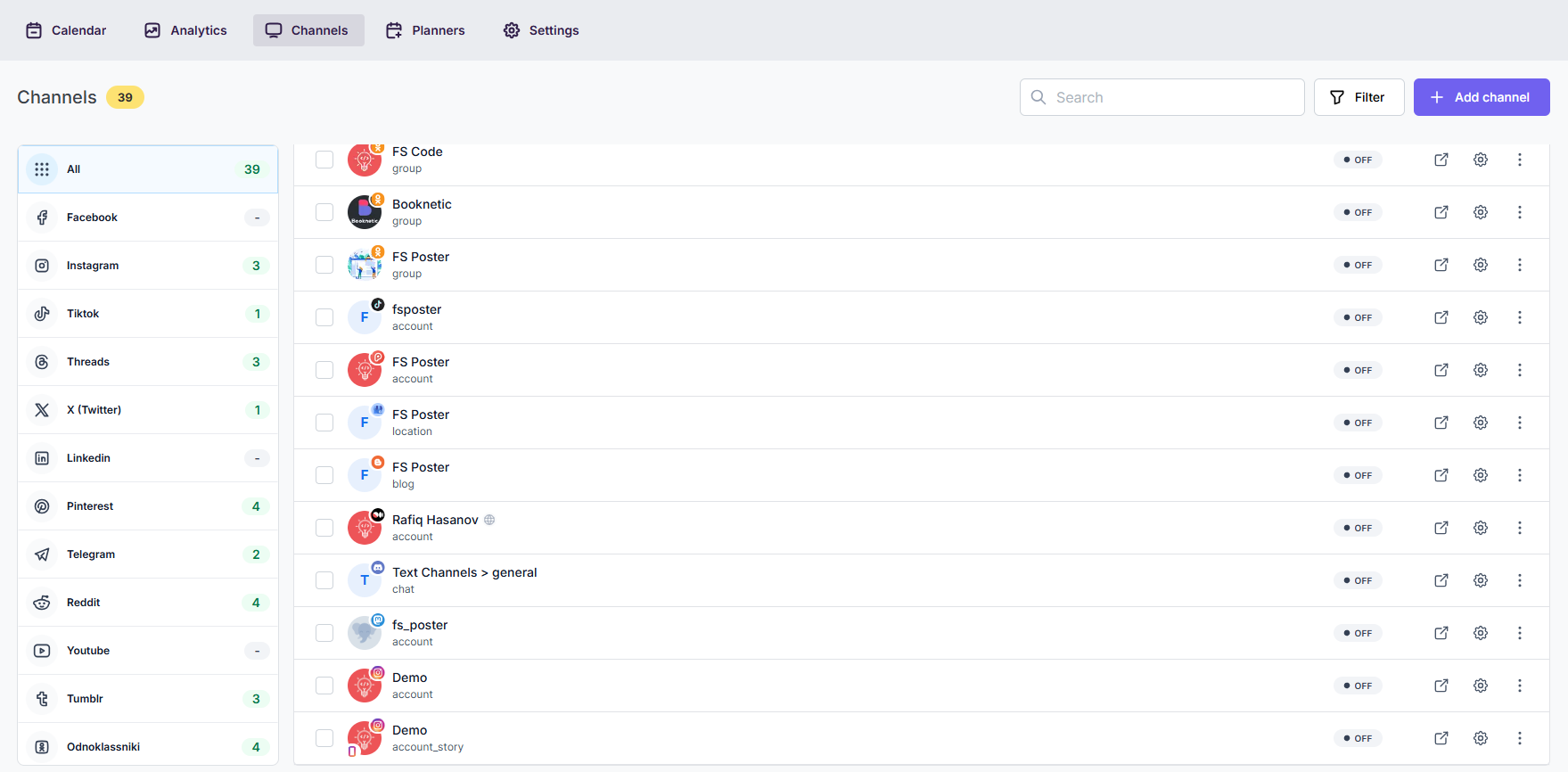
For a typical WooCommerce store, a healthy starting set looks like this:
- Facebook page for product cards and link clicks.
- Instagram business account for visual feed posts and carousel launches.
- Pinterest business account for catalog-style discovery, especially in apparel, home, beauty, and craft niches.
- LinkedIn company page for B2B catalogs and higher-ticket products.
- X (Twitter) for short, link-led restock and launch announcements.
- Telegram channel if you broadcast deals or restock alerts to a subscriber list.
FS Poster also covers Threads, TikTok, YouTube Community, YouTube Shorts, Google Business Profile, Reddit, Tumblr, Medium, Blogger, Bluesky, Mastodon, Truth Social, VK, OK.ru, Xing, Plurk, Discord, Flickr, and a generic Webhook destination, so you can add channels later without changing tools.
Two practical setup rules:
- Connect business assets, not personal profiles. A Facebook personal profile cannot run product campaigns properly. Connect the Page, the Instagram business or creator account, and the LinkedIn company page.
- Name channels so your auto-share rules are obvious. If you run a brand account and an outlet account, label them clearly inside FS Poster. The filter rules in the next section depend on that naming.
4. Set a default WooCommerce product message
The default message decides what every auto-shared product looks like before you do any per-product customization. A solid template stops you from rewriting captions for every SKU.
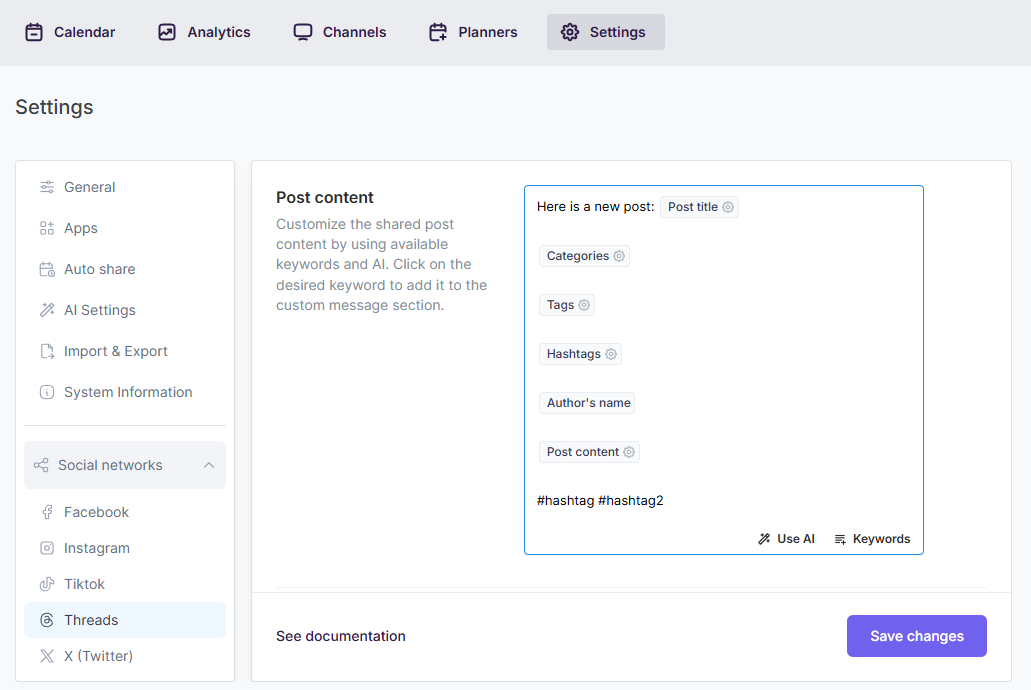
In FS Poster » Settings » Custom Post Types, enable the product post type. Then open the message editor for WooCommerce products and build a template using FS Poster's content variables. A working baseline:
🛍 New in: {post_title}

{post_excerpt}

Shop now: {post_url}
#{site_name} #{category}
Patterns that earn clicks in store feeds:
- Lead with the product name and a verb. "New in", "Back in stock", "Last few", or "Bundle of the week" wins the first line. Followers should know what they are looking at without expanding the caption.
- Use the excerpt, not the long description. A caption is not a category page. One or two lines is enough.
- Always include the product URL on feed posts. Stories and Reels can drop it, but for feed posts the link is the conversion path.
- Vary per network. X needs a short version; LinkedIn likes a slightly more professional tone. FS Poster lets you set per-channel templates so you do not have to settle for one universal caption.
- Skip dynamic price claims unless your store data is rock solid. If your prices change with currency, tax, or promotion, leave price out of the template and put it on the landing page.
5. Enable auto-share for WooCommerce products
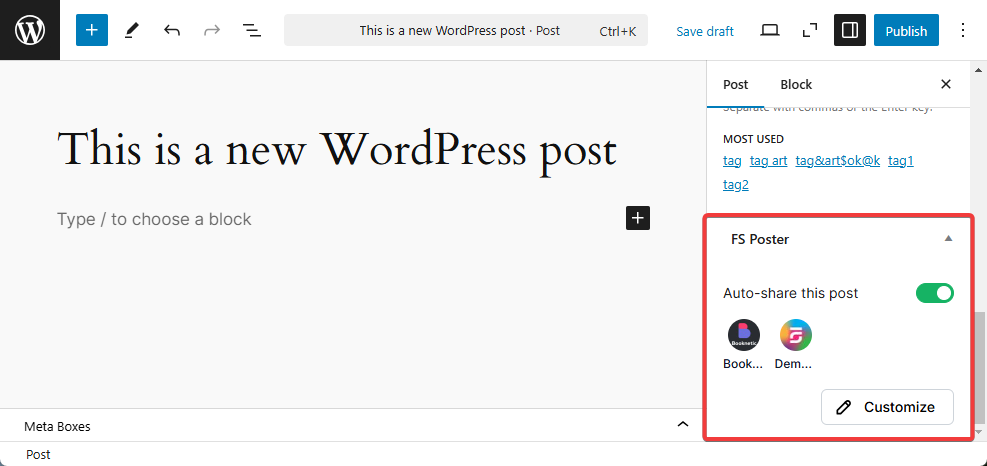
Auto-share turns FS Poster from a manual scheduler into a real WooCommerce auto poster. Once the WooCommerce product post type is enabled, every newly published or updated product can be pushed to the channels you select, with the template you set in the previous step.
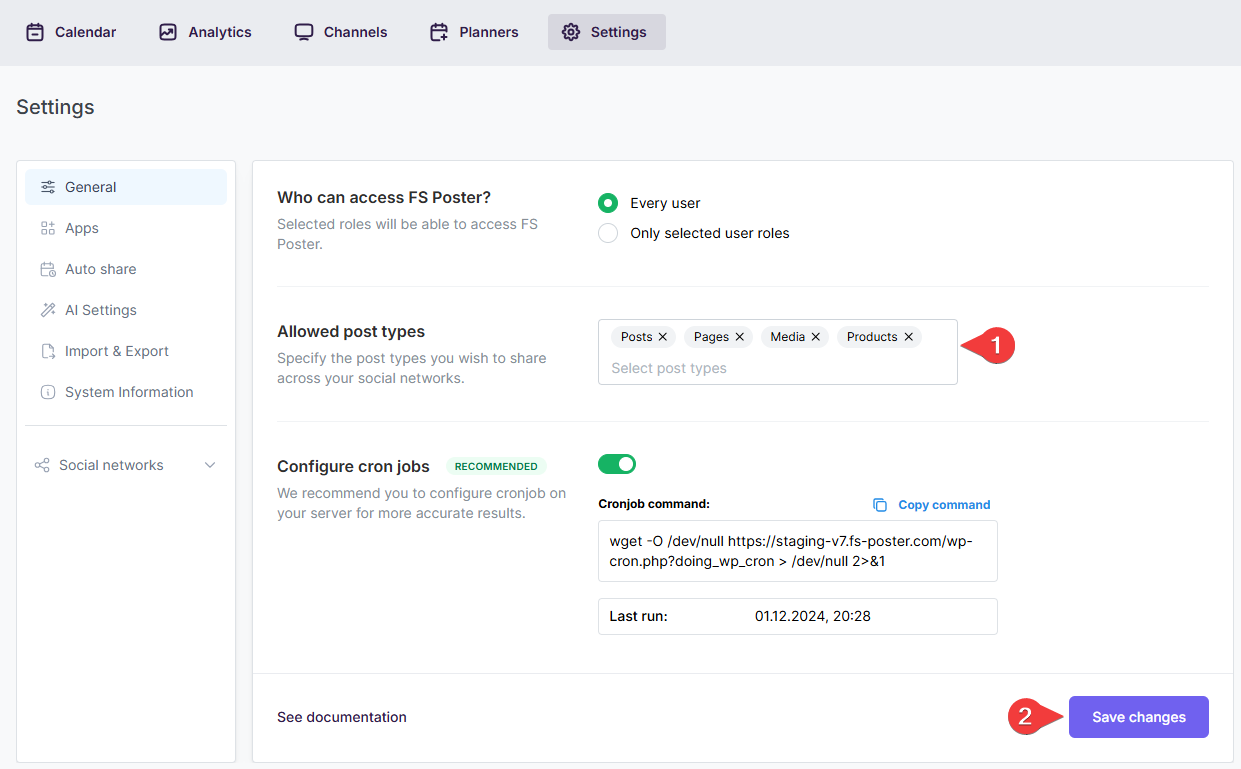
The flow is straightforward:
- Open FS Poster » Settings » Auto-share.
- Enable auto-share for the
productpost type. - Pick the channels that should receive product posts by default. Resist the urge to tick every channel. Start with two or three where you have an audience.
- Decide whether updates to existing products should re-share or stay quiet. Most stores want "publish only" so a price typo correction does not spam followers.
- Save and publish a test product. Confirm the post lands on every channel with the right caption, image, and URL.
Because FS Poster is the WordPress scheduling plugin with custom post types support, the same flow extends to WooCommerce-style content that lives outside the default product CPT: variations registered as standalone posts, "deal" or "lookbook" custom post types, and third-party extensions that register their own CPT (subscriptions, bookings, course products).
For larger catalogs, do not enable auto-share for the entire product CPT in one go. Use the filter rules in the next section so only the SKUs you actually want on social get pushed.
6. Use product categories and tags as filters
This is where most WooCommerce stores get real value out of automation. You almost never want every product on every channel. Sale items, low-stock items, hidden bundles, B2B-only SKUs, and discontinued products should each be treated differently.
FS Poster builds positive and negative filter rules from product categories and tags, so the right product reaches the right channel.
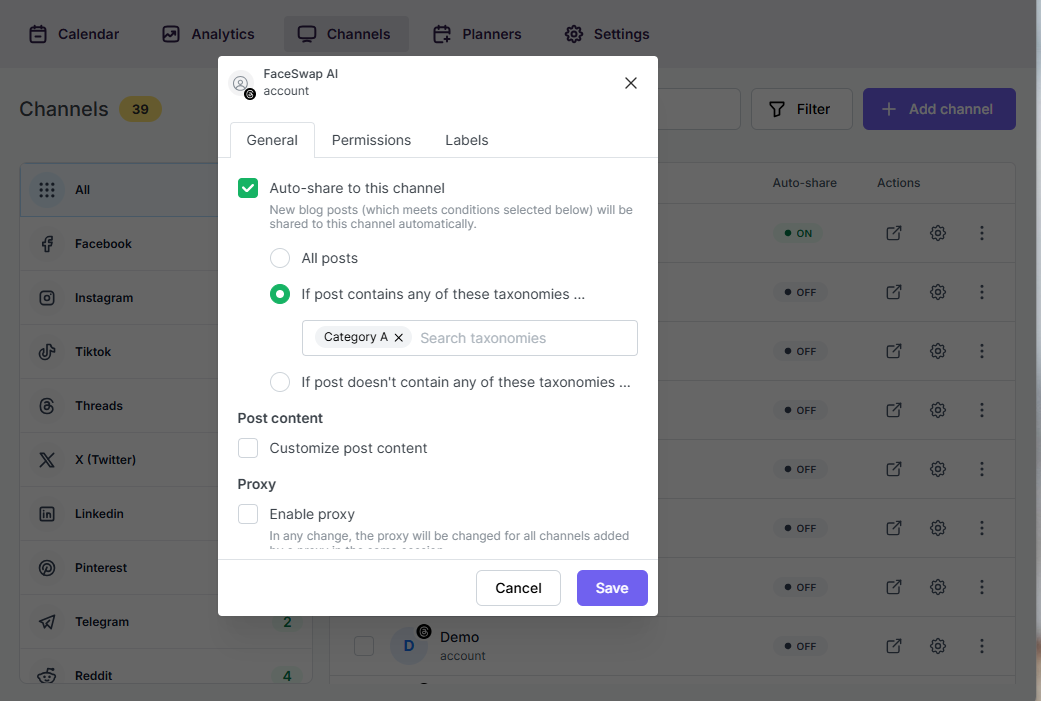
Patterns that work for real stores:
- Launch-only feed. Auto-share to Instagram only if the product is in the "New arrivals" category. Your launch grid stops getting buried under restocks.
- Stock guards. Never auto-share products tagged
out-of-stock,low-stock,backorder,B2B-only, orinternal. Your social posts stop linking to dead or unsellable carts. - Seasonal exclusions. Tag seasonal SKUs with
seasonal-winterorseasonal-summer, and let Planner pick them up only in the right window instead of all year. - Channel split by category. Send "Apparel" categories to Instagram and Pinterest; send "Software", "Services", or "B2B" categories to LinkedIn and X.
- Language split. If you run WPML or Polylang, a
lang:enorlang:detag makes sure English products go only to English-language channels. - Discount discipline. Tag sale SKUs with
saleand reserve Pinterest and Telegram for those, so promotional content does not flood the always-on launch feed.
The point of filters is that a single auto-share configuration covers a full catalog without manual triage. You set the rules once and the plugin enforces them on every publish.
7. Auto-post products to Facebook, Instagram, and LinkedIn
Most WooCommerce social traffic still comes from Facebook, Instagram, and LinkedIn. Each one rewards a slightly different post shape, and FS Poster lets you respect that without doubling the workload.
Post WooCommerce products to Facebook
Facebook pages reward link-led product cards with a single clear CTA. With FS Poster connected to your Page, every new product fires a post that includes the product image, the caption from your template, and the product URL. Useful patterns:
- Put hashtags in the first comment, not in the main caption, so the page feed stays readable.
- Append a Facebook-specific UTM (for example
utm_source=facebook&utm_medium=social&utm_campaign=launch_q3) in the URL builder so GA4 attributes checkouts. - Boost only the products that already earn organic engagement. The auto-share log makes the winners easy to spot.
- For restocks, set a Facebook-only Planner job at a 2 to 3 week cadence so the page does not look quiet between launches.
For deeper Facebook setup, see auto-post WordPress posts to Facebook.
Post WooCommerce products to Instagram
Instagram cares about visuals first. FS Poster supports Instagram feed posts, carousel scheduling, and Story-style assets, which is more than most WooCommerce stores actually use. A safe baseline for stores:
- Feed post with the product hero image and a one to two line caption that names the product and the benefit.
- Carousel for products that have multiple gallery shots, where the second slide can be lifestyle and the third a benefit list or sizing chart.
- Custom image when the default product photo is not square-friendly. FS Poster's custom image field lets you swap in a 1:1 or 4:5 crop without touching the WooCommerce gallery.
- Reels-style assets for launch days, scheduled from the same composer so they live next to the feed posts in the queue.
For the Instagram connection itself, see auto-post to Instagram from WordPress.
Post WooCommerce products to LinkedIn
LinkedIn is the channel most WooCommerce stores under-use. It works well for B2B catalogs, high-ticket physical products, software licenses, and services sold via WooCommerce. The rules of thumb:
- Use a more professional template variant: no emoji at the top, a benefit-led first line, and a clearer CTA.
- Filter so only SKUs that fit a business buyer go through. The category filter from the previous section is the easiest way to gate this.
- Avoid daily product spam. Three to five high-quality product posts per week beat one per day.
- For service-style WooCommerce products (consulting, software licenses, course access), pair the auto-share with a manual LinkedIn comment from a real employee. FS Poster handles the post; the comment is what earns the conversation.
For the LinkedIn setup, see auto-post to LinkedIn from WordPress.
8. Schedule product campaigns from Calendar
Auto-share takes care of the steady drip. Calendar is the surface for planned campaigns: product drops, holiday sales, bundle weeks, seasonal restocks, and pre-launch teasers.
Open FS Poster's calendar view and you get a multi-week grid of every queued post across every channel. From there you can:
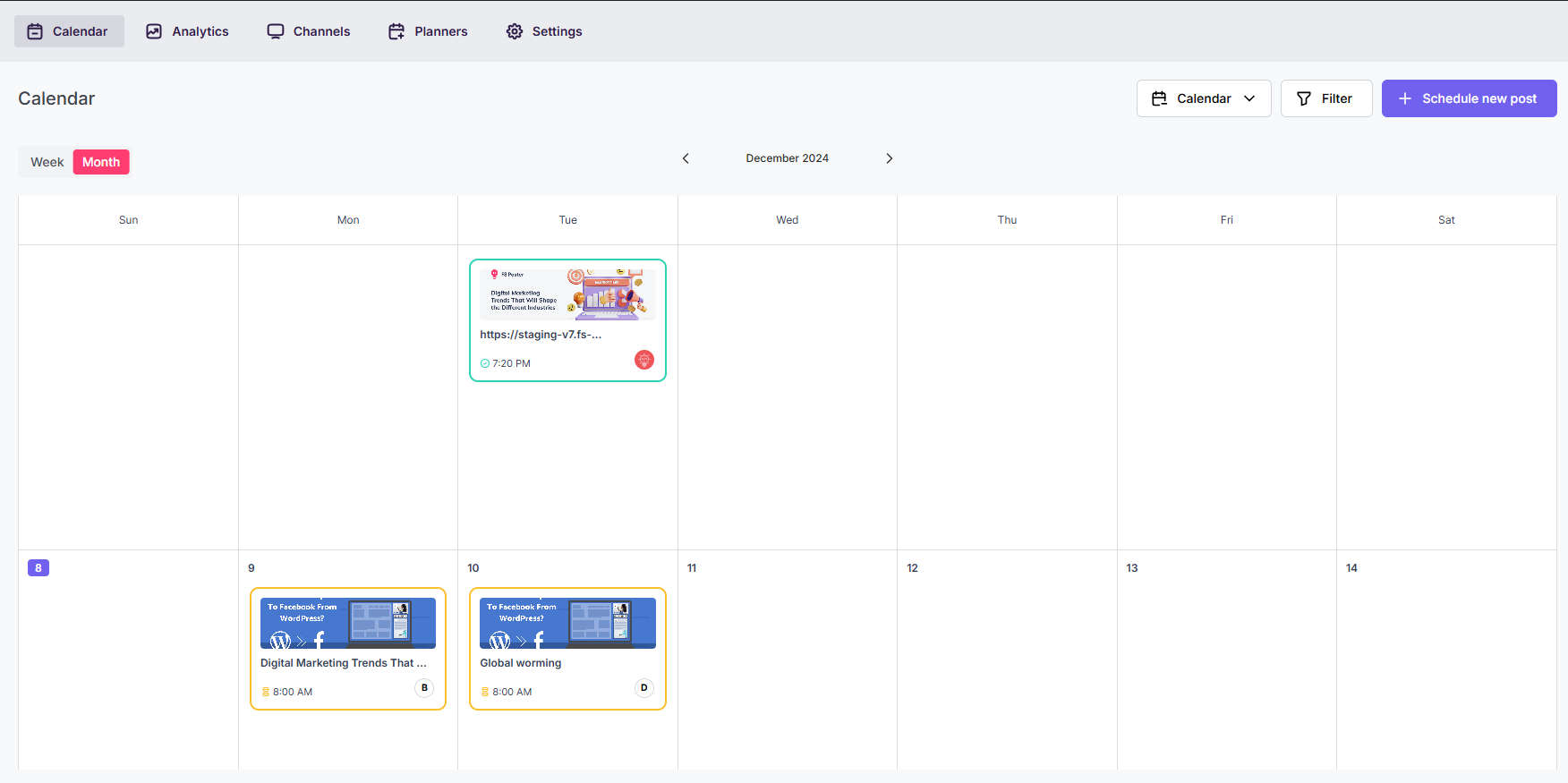
- Drag and drop posts between days to reshape a launch week without re-typing captions.
- Build campaign blocks where the same product is shared multiple times with different angles: feature, benefit, social proof, last-call.
- Bulk-schedule from the WooCommerce product list when you want to push a whole category across the next 14 days at custom intervals.
- Spot gaps before they happen. A Friday with no scheduled product is obvious in the grid two weeks before it lands silent.
- Coordinate the team. Roles can be assigned per user, so a content writer drafts the messages, a marketing lead approves the schedule, and the store owner just watches the queue fill up.
Calendar is also where launches stop overlapping by accident. If two collections are about to drop in the same week, the grid surfaces it before the posts go live.
9. Recycle old and evergreen products with Planner
Most WooCommerce catalogs have a long tail of evergreen products that quietly convert for years. Planner is the FS Poster feature that keeps them visible on social without you babysitting them.
From the Planner documentation, the setup looks like this:
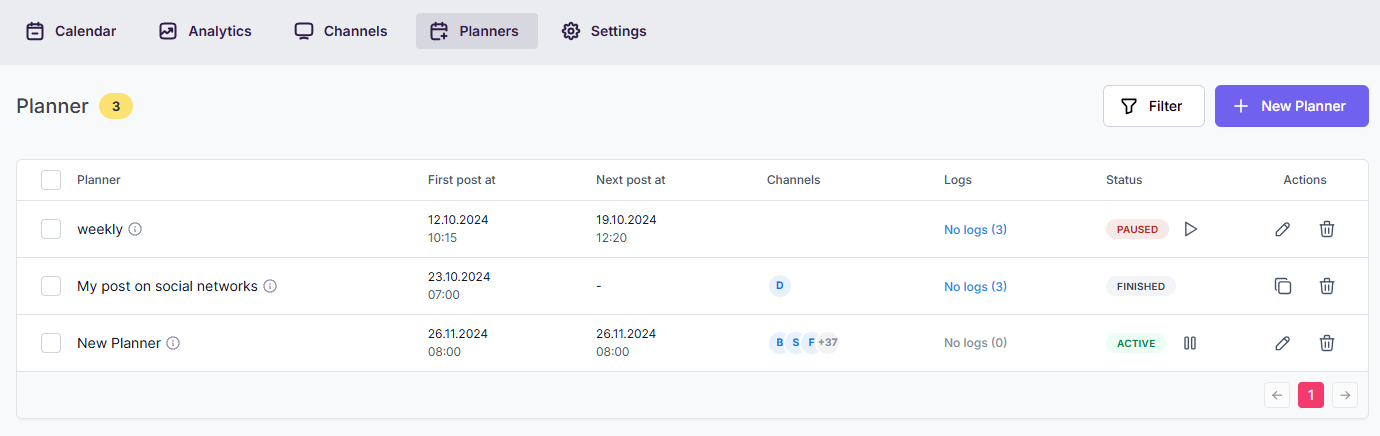
- Create a new Planner job and select the
productpost type as its source. - Apply category or tag filters so only evergreen products are eligible. Most stores exclude
sale,seasonal,out-of-stock, andexclude-from-plannertags. - Pick the channels you want to feed. Pinterest, Facebook, and X absorb this kind of repetition best.
- Choose a recycling interval per channel. Most stores land on every 1 to 2 weeks for Pinterest, every 3 to 4 weeks for Facebook, and weekly for X.
- Pick the rotation order: random without duplicates, newest first, or oldest first.
Guardrails that keep Planner safe:
- Add an
exclude-from-plannertag for any product you do not want recycled, and use it as a negative filter so the rule survives future taxonomy changes. - Audit Planner output monthly. Algorithms move, captions go stale, and a product that converted in March may need a fresh hero image by September.
- Use FS Poster's click-tracking log to retire products that get zero clicks no matter how many times they are recycled. Recycling does not fix a weak product page; it just amplifies it.
- Pause the Planner job during peak launch weeks so a recycled evergreen does not compete with a brand-new product for the same audience slot.
10. Use AI for product captions and images
Caption fatigue is real. After a few hundred SKUs, every product starts to sound like the last one. FS Poster's AI integration reduces that load by generating captions, hashtags, and even custom image variants on demand.
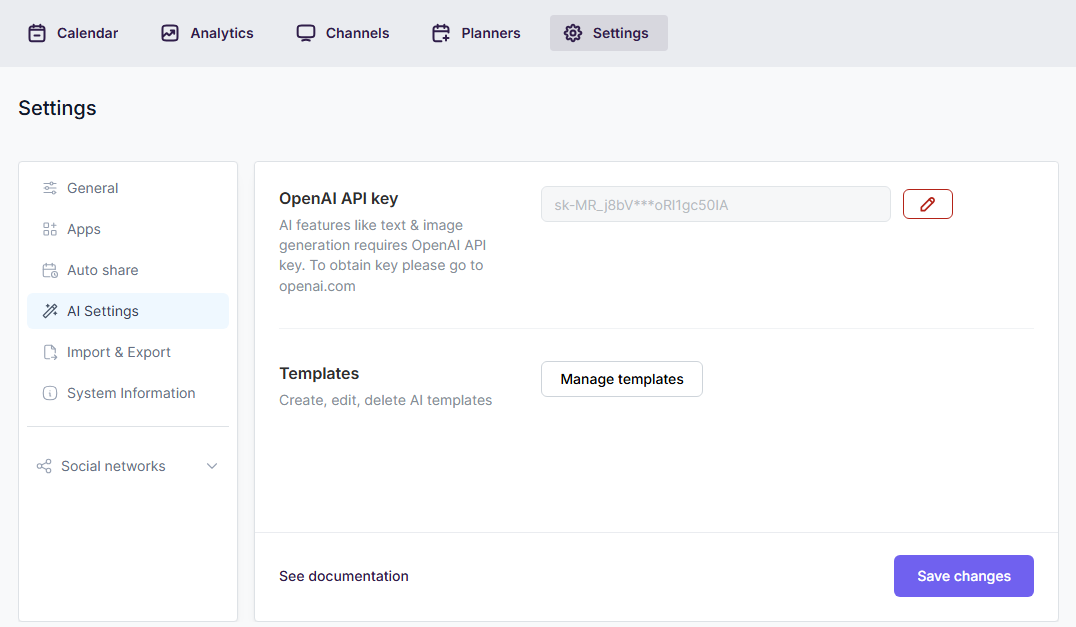
Inside the share dialog, two AI helpers matter for WooCommerce stores:
- AI text generation. Feed it the product title, a one-line description, and a target tone. You get several caption variants tuned to the channel (short for X, benefit-led for LinkedIn, lifestyle-led for Instagram). You keep editorial control: pick a variant, edit a line, push the post.
- AI image generation. When the product photo is too plain for Instagram or Pinterest, generate a stylized variant (flat-lay, gradient background, seasonal mood) without commissioning a photographer for every SKU.
Guardrails so AI stays an asset and not a liability:
- Read every generated caption before publishing. AI sometimes invents claims a WooCommerce store cannot back up.
- Stay on-brand. Pre-load your prompt with the tone of voice (playful, minimalist, technical) and the product category, so the output stops sounding like a generic marketplace listing.
- Keep human review on any post that mentions price, stock, claims, warranties, certifications, or anything regulated.
- Do not let AI write the legal disclaimer. If your category needs one, hand-write it once and store it as a snippet in the message template.
11. Measure and tune the WooCommerce auto-posting workflow
Setting up auto-share, Calendar, Planner, and AI is only the first half of the job. The other half is closing the measurement loop so the queue keeps getting smarter.
A measurement routine that works for most stores:
- Per-channel UTMs. Every auto-share must carry a network-specific UTM so GA4 attribution actually works. Without UTMs, "social" stays a black box.
- Per-product clicks. FS Poster's own click-tracking log shows which auto-shared posts earn clicks. Products with strong clicks and weak conversions point to a landing-page problem, not a social problem.
- Per-template tests. If you have two caption templates for a category, rotate them in Calendar and compare click and revenue side by side. Keep the winner; archive the loser.
- Per-channel cadence. Cap the daily volume. Auto-share plus Planner can flood a Facebook page if you are not careful. Most stores do well with 1 to 3 auto-shares per channel per day, max.
- Quarterly catalog review. New categories, new SKUs, new product types. The setup that worked in Q1 will be wrong by Q3 if you do not touch it. Re-audit filters, templates, and Planner jobs every three months.
- Coordinate with email. If a launch goes to email on Tuesday, schedule the social rollout to lead and follow it, not to compete with it.
- Compare against the wider stack. If you have not picked your full social tooling yet, scan WordPress social media plugins for the related share-button, feed, and analytics tools that pair well with an auto-poster.
12. FAQ
Can FS Poster auto-share both blog posts and WooCommerce products?
Yes. FS Poster handles WordPress posts, pages, WooCommerce products, and other custom post types in the same dashboard. You can keep one auto-share rule for blog posts and a different rule, with different channels and templates, for WooCommerce products.
How many social networks can I auto-post WooCommerce products to?
FS Poster supports 25+ networks and services in a single install, including Facebook, Instagram, Pinterest, LinkedIn, X, Threads, TikTok, YouTube Community, YouTube Shorts, Google Business Profile, Telegram, Reddit, Bluesky, Mastodon, Tumblr, Medium, Blogger, Discord, Flickr, VK, OK.ru, Xing, Plurk, Truth Social, and a generic Webhook destination.
Will FS Poster spam followers if I bulk-update products?
Only if you configure it that way. The recommended setup is to enable auto-share for "publish" actions only, so price corrections, stock updates, and editorial fixes do not trigger fresh posts. For intentional re-shares, the Planner is the safer tool.
Can I filter by WooCommerce category or product tag?
Yes. The Auto-share rules support both inclusive ("only share products in X category") and exclusive ("never share products tagged Y") filters. Most stores combine both: launches go out automatically, while sensitive SKUs (B2B, low stock, internal) stay private.
Does FS Poster work with variable products and product variations?
FS Poster targets the parent product by default, which is what most stores want for social posts. The variation pages are not auto-shared separately, which keeps the feed clean and avoids duplicate posts for the same product in different sizes or colors.
How do I track which WooCommerce auto-posts actually drive sales?
Two layers. FS Poster's click tracking shows which auto-shared posts earn clicks. Pair that with a per-channel UTM on the product URL, and GA4 will attribute the resulting sessions and revenue. Together, you can see which channel, which template, and which product actually convert.
Do I need a separate SaaS scheduler if I already use FS Poster?
Most WooCommerce stores do not. FS Poster covers the auto-share, Calendar, Planner, and AI workflows that store owners usually buy a separate SaaS tool for. The case for adding a SaaS scheduler on top is only strong when you have a large multi-brand team that needs SaaS-grade collaboration, an inbox tool for DMs, social listening, or paid-ads orchestration outside WordPress.
What about pricing?
FS Poster offers annual plans plus a one-time lifetime tier on the pricing page. The lifetime option tends to win on long-run economics for stores that plan to keep WooCommerce as their commerce stack for years. Pricing changes from time to time, so check the live pricing page for the current numbers before you buy.
Write once. Post to 26 networks.
- 26 social networks
- Schedule & auto-repost
- Runs inside wp-admin


